
🌍 This Week in Web3ForGood
aid rewired, stablecoins to street cash, defi doom spiral
Web3forGood is a weekly publication that celebrates and critically analyzes how emerging web3 technology could be used to make the world a better place.
gm gm,
Not a great week for DeFi on the timeline. Great week for DeFi IRL.
For years, the promise of crypto in humanitarian aid has been fast in theory, but clunky in practice. That story is changing. A new pilot from MCV this week reimagines aid delivery, and infrastructure players like MoneyGram and Stellar are finally solving the final mile problem.
In other words, the gap between what is trending on social media and what is actually being built is real. We’re breaking down all of it.
WAGMI (we are going to make an impact!)
P.S. Celo officially turned six this week 🎉. HBD to a blockchain that has spent those six years doing the real work.
What’s Inside
📚 What We’re Thinking About
📣 Latest News
🔈 Watch & Listen
🚀 Opportunities & Calls to Act
🎪 Events
📡 On Our Radar
✨ And One More Thing
📚 What We’re Thinking About
🌱 Aid, Rewired: How Stablecoins + Privacy Tech Could Redefine Humanitarian Cash
A compelling pilot from Mercy Corps Ventures explores how stablecoins and privacy-preserving tech can reshape humanitarian cash transfers. By combining fast, low-cost digital payments with zero-knowledge tools, the model protects sensitive user data while ensuring aid reaches displaced communities efficiently. Integration with familiar platforms like WhatsApp lowers access barriers, avoiding the need for formal banking infrastructure. The result is a more dignified, user-centric approach to aid, one that prioritizes both speed and safety. If it scales, this could signal a broader shift toward digitally native, privacy-first humanitarian systems that better reflect how people actually live and communicate.
Here’s how it actually works. Mercy Corps Ventures is partnering with Aleo, Humanity Link, and the Danish Refugee Council to onboard around 300 Venezuelan refugees, Colombian returnees, and host community members in the border regions of Norte de Santander and Santander. Over six months, participants will receive roughly $15,000 in privacy-preserving stablecoin (USDCx) transfers through individual and group wallets, the latter built around the village savings and loan associations that already anchor trust in these communities. Zero-knowledge proofs let aid organizations verify that someone is eligible without ever seeing or storing their personal data, which matters enormously in regions where armed groups actively hunt for information about residents. Participants access their funds via WhatsApp in Spanish, and for those without smartphones, NFC smart stickers let them complete a transaction with a simple tap. It is the first time privacy-preserving USDCx is being deployed in a humanitarian setting.
If it works, the playbook stops being theoretical. Every agency running cash programs in high-risk regions will have a model to look at, and a reason to rethink what they ask people to disclose just to survive.
🛣 From Stablecoins to Street Cash: The Off-Ramp Just Got Real
The expanded partnership between MoneyGram and Stellar makes stablecoin off-ramping far more practical. Everyday users can convert digital dollars (like USDC) into local cash at thousands of locations worldwide, often without needing a bank account. This means faster, cheaper cross-border transfers. Funds can move instantly on-chain and be withdrawn in cash locally. It’s especially impactful for people in cash-based or underbanked economies, where accessing traditional banking is difficult. Ultimately, this bridges the biggest gap in crypto by turning stablecoins into usable, real-world money that can be easily spent in everyday life.
⚠️ The DeFi Doom Spiral, and What’s Missing from the Conversation
If you spent any time on crypto social media this week, you probably caught the mood. It was dark. The trigger was a $293 million exploit of Kelp DAO, a decentralized finance protocol, which then spiraled into nearly 40% of deposits fleeing Aave, the largest DeFi lender, in a single week.
Here is the short version for anyone who does not live in this corner of the internet. DeFi, short for decentralized finance, is the part of crypto focused on rebuilding financial services like lending, borrowing, and trading without banks or middlemen. The premise is that code is more trustworthy than institutions, and that regular people should be able to access financial tools without asking anyone’s permission. This week’s hack has a lot of people questioning whether that vision is even possible.
The pessimism is not unfounded, and we are not going to pretend otherwise. When speculative yield farming and exotic layered tokens dominate what DeFi actually does in practice, a catastrophic hack looks more like a verdict than a setback.
Here is what gets lost in the doom, though. DeFi's tools work best, and reveal their actual value, when they are building things that help people live rather than helping rich people get richer. The same smart contracts that power a $293 million exploit could also be powering affordable remittances, inflation-proof savings, and peer-to-peer lending for people who have never been allowed near a bank. Celo, which is celebrating its sixth birthday this week, is home to a small but growing DeFi ecosystem doing exactly that, with protocols like Moola letting users lend and borrow in stablecoins from a basic smartphone in places where traditional banking never reached. The industry's obsession with yield-chasing is a choice, not a feature of the technology. A different choice is being made by people who are too busy building to post about it, and that is the version of the story we are tracking.
Plus:
🎤 5 Things I Learned in Conversation with Josh Davila, The Blockchain Socialist: “The goal of the cryptoleft is a fairer society; technology and blockchains are just a tool in the shed in order to achieve it. I believe that until people’s needs are met, we shouldn’t be dismissing tools that can put these systems in place. Literally anyone can use it, after all, and this is by design. We won’t know if it’s possible until we try.“ (Marvyn Paul)
🌐 Code is Speech: “Coin Center published the most comprehensive legal research report on the current state of First Amendment protections for developers.“ (@valkenburgh)
📣 Latest News
Open Cities Lab Joins the Digital Public Goods Alliance to Advance African-Led DPI Implementation
DoorDash is bringing stablecoin payments to masses with Stripe-backed blockchain
MiniPay Contributes up to $1 Million CELO to Back Mini App Builders & Launches Roadshow
Iran views BTC as strategic asset, but USDt still dominates oil tolls: BPI
Vitalik laid out Ethereum’s 4-year roadmap at Hong Kong’s Web3 Festival
Global Policy, Regulation, and Adoption News
Uzbekistan creates state-backed crypto mining zone with tax breaks
UK plans payments rule changes for stablecoins, tokenized deposits
Bank of Korea governor backs CBDCs, deposit tokens in first address
Japan to test government bonds as digital collateral on Canton
Reports / Project Updates
🔈 Watch & Listen
Crypto Altruists - Episode 248 - From Local Hubs to Global Hackathon: Empowering the Next Generation of Web3 and AI Builders, with Dev3pack
Green Pill - VDAO - Episode 10 - Humans as a Keystone Species: Regeneration, Crypto & the Meta-Crisis | Gregory
Green Pill - Season 10, Episode 11 - $170M to Fix Ethereum Security (After Another Major Hack) | Griff Green
Human Rights Foundation and PubKey - How Freedom Tech Wins (w/ Calle & HRF)
Extrapolate with Rob Hof - The Techno-Progressive Future: UBI, AI, and and the Left – James J. Hughes
🚀 Opportunities & Calls to Act
Nominate: The 50-in-5 Awards from the Digital Public Goods Alliance celebrate countries and individuals demonstrating advancing safe, inclusive, and interoperable DPI (digital public infrastructure). The awards highlight digital cooperation, the positive change driven by digital public infrastructure, and the individuals making a difference — showcasing lessons learned and best practices for other countries globally.
🎪 Events
🆕= New to the roundup this week
Virtual
Seminar: “Blockchain Security: Code, Crisis, Community” (BOOK LAUNCH) with Dr. Kelsie Nabben is happening Wednesday April 29
Making Digital Infrastructure Work for Women and Girls: Exemplar Stories is happening April 29. 🆕
DWeb Virtual Meetup—Sneak Peek: Projects Coming to Camp is happening April 30.
Everyone Should Shape the Future of AI: Ensuring Public Input is happening April 30. 🆕
Regeneration Pollination - First Friday! - Connecting Turtle Island West is happening May 1. 🆕
IRL
All Tech Is Human’s Responsible Tech Mixer is hapening April 27 in DC.
The “Freedom Go Up” stage, hosted by Human Rights Foundation, at Bitcoin 2026 is happenin April 27–29 in Las Vegas.
Stanford Blockchain Governance Summit 2026 is happening May 2-3 in Stanford, CA.
RightsCon 2026 is happening May 5-8 in Zambia.
Bitdeer X ACJR Awards are happening May 7 in Miami Beach.
ETHCluj is happening May 13-14 in Cluj-Napoca, Romania.
ETHGlobal Prague is happening May 30 - June 1 in Prague.
Edge Esmeralda is happening May 30 - June 27 in Healdsburg, California.
The Oslo Freedom Forum is happening June 1-3 in Oslo, Norway.
The Philosophy of Brain-Computer Interfaces: A Neurotechnology and Society Conference is happening June 5-6 in Boston.
Foresight Institute’s Vision Weekend United Kingdom 2026 is happening June 5-7 in London.
ETHConf is happening June 8-10 in NYC.
East Africa Adopting Bitcoin Conference is happening June 24-26 in Nairobi.
DWeb Camp 2026 is happening July 8–12 in Alte Hölle - Brandenburg, Germany.
DWeb Camp Cascadia is happening July 30 - August 3 on Salt Spring Island, BC, Canada.
Crypto Commons Gathering is happening August 16-22 in Reichenau an der Rax, Austria.
Valley of the Commons is happening August 24 - September 20 in the Austrian Alps.
Boston Blockchain Week is happening September 8-10 in Quincy, MA.
The Gathering is happening September 11-15 in Portugal.
The Technoprogressive Opportunity is happening September 19-20 in London.
Progress Conference 2026 is happening October 8-11 in Berkeley, CA. 🆕
Responsible Tech Summit: Embedding Accountability in the AI Era is happening October 29 in NYC.
Devcon 8 is happening November 3-6 in Mumbai, India.
The Africa Bitcoin Conference is happening December 2-5 in Blantyre, Malawi.
Recurring
Monthly Earth Day is a global event that happens on the 22nd every month, not just once a year. Get involved next on May 22.
📡 On Our Radar
Rahat is a collection of open-source, blockchain-powered projects for cash and aid distribution and management. It enables the efficient and transparent coordination of resources and relief efforts.
CodeCarbon is a lightweight software package that seamlessly integrates into your Python codebase. It estimates the amount of carbon dioxide (CO2) produced by the cloud or personal computing resources used to execute the code.
ChapSmart connects Bitcoin to everyday life in Tanzania.
✨ And One More Thing
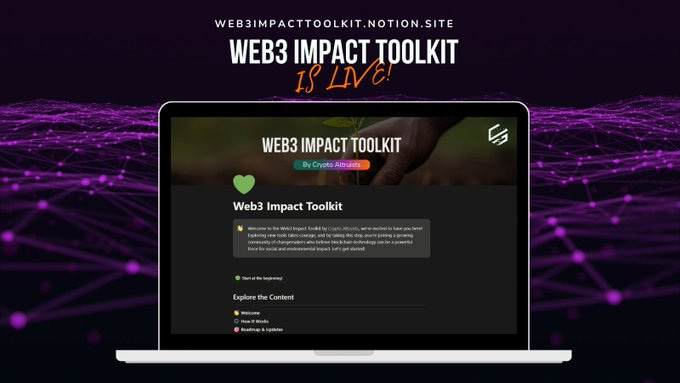
Crypto Altruists launched the Web3 Impact Toolkit, a free, self-paced resource built for nonprofit professionals who want to move from curiosity to action without having to become crypto experts first. Learn more.